
Has Elon Musk Completely Abandoned Dogecoin? Here’s The Last Time He Tweeted About It
March 13, 2026

The Federal Reserve is set to open a new chapter in the US Basel III debate next week, and for Bitcoin policy advocates the stakes are unusually clear: whether the largest American banks will keep inheriting a capital regime that treats bitcoin as effectively untouchable. The fight centers on Basel’s 1,250% risk weight for certain crypto exposures, a calibration critics say makes regulated bank participation in Bitcoin uneconomic by design.
Bitcoin’s ‘Toxic’ Basel Label Heads For Public Review
Conner Brown, managing director at Bitcoin Policy, cast the coming proposal as a direct opening for that debate. “The Federal Reserve just announced that next week they will be issuing a public proposal for how Banks should implement Basel risk weighting guidance for America’s largest banks. Bitcoin is currently treated as a toxic asset under Basel regulations, subject to a 1250% risk weighting, harsher than virtually all other asset classes. This risk weighting makes it extremely difficult for banks to provide financial services to Bitcoiners and Bitcoin companies.”
That timing tracks with the Fed’s broader capital overhaul. In a March 12 speech at the Cato Institute, Fed Vice Chair for Supervision Michelle Bowman said the central bank would, “in the coming weeks,” propose rules to implement the final phase of Basel III in the United States, alongside related changes to other capital requirements. Reuters reported that the Fed will vote on the proposal next week, after which the package is expected to be opened for a 90-day public comment period.
Brown’s accompanying essay, “Basel’s 1250% Mistake,” argues that the current treatment is a “category error.” His case is that Basel applies the harshest capital bucket to an asset he describes as transparent, globally traded and free of counterparty risk, rather than treating Bitcoin through existing market-risk and operational-risk frameworks. In the paper’s most important mechanical point, Brown argues that a 1,250% risk weight, multiplied by the 8% minimum capital ratio, translates into a capital requirement equal to 100% of the exposure before buffers and internal targets are added on top.
That is why the issue goes beyond whether a bank wants bitcoin on its own balance sheet. Brown argues the current rule does not just discourage holdings; it undermines the economics of bank intermediation around the asset more broadly. In his telling, once the framework makes Bitcoin exposure prohibitively expensive, custody, financing and other regulated services for bitcoin companies become harder to offer at scale, widening the gap between institutional demand and the banking system’s ability to meet it.
The Fed’s proposal itself is not being marketed as a crypto-specific rewrite. Bowman’s speech focused mainly on recalibrating capital rules across lending, market risk, operational risk and systemic bank surcharges so they better reflect what regulators view as actual risk. But for Bitcoin policy groups, the coming comment window creates a rare opening to challenge whether US regulators should import Basel’s most punitive crypto treatment unchanged, or move toward a framework based on measurable risks rather than a flat deterrent.
At press time, Bitcoin traded at $71,394.
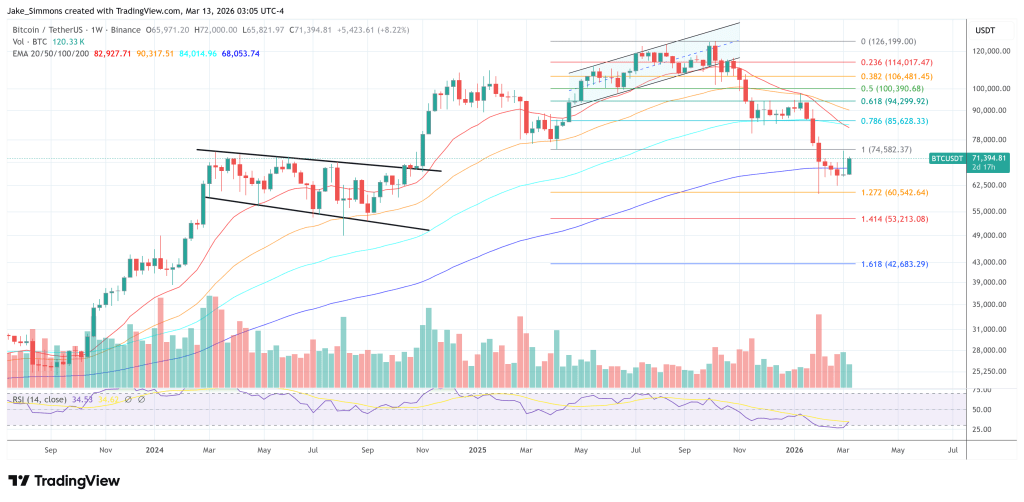
Featured image created with DALL.E, chart from TradingView.com
Editorial Process for bitcoinist is centered on delivering thoroughly researched, accurate, and unbiased content. We uphold strict sourcing standards, and each page undergoes diligent review by our team of top technology experts and seasoned editors. This process ensures the integrity, relevance, and value of our content for our readers.
ANTMINER™ TEAM 𝓟𝓻𝓸